November 16th, 2011, Google officially and publicly entered the music distribution market with it’s Google Music service. Offering (in it’s beta version) a “locker” for music files in which the users could store up to 20,000 of their songs. Later on, a partnership with major record labels such as Sony and Universal gave users of Google Music an access to a database of 13 million tracks ready for online purchase.
Google’s first foot in the music streaming industry was in May 2013 with the launch of an “All Access” service on the newly named Google Play Music, allowing the user to listen to unlimited music for $9.99 per month. The biggest competitor at the time is Spotify, followed by Napster and Rhapsody. Spotify having (in 2013) more than 15 million titles in its database, 24 millions users, with a quarter of them paying for the premium plan.
In parallel, Google’s online video streaming platform YouTube, has been (by 2006) a go-to solution for music consumption, offering free and efficient media content streaming. With over 800 million users every month in 2012, it certainly steals a lot of potential customers out of the hands of the “real” dedicated music distributors. Never before did we have the ability to listen to almost any music for free on a massive scale.
Streaming music on YouTube seemed too good to be true. Users benefited from a full free music service, available on a variety of platforms, accessible anywhere with occasional ads. Things can’t work as perfectly, and be profitable for both consumers and creators.
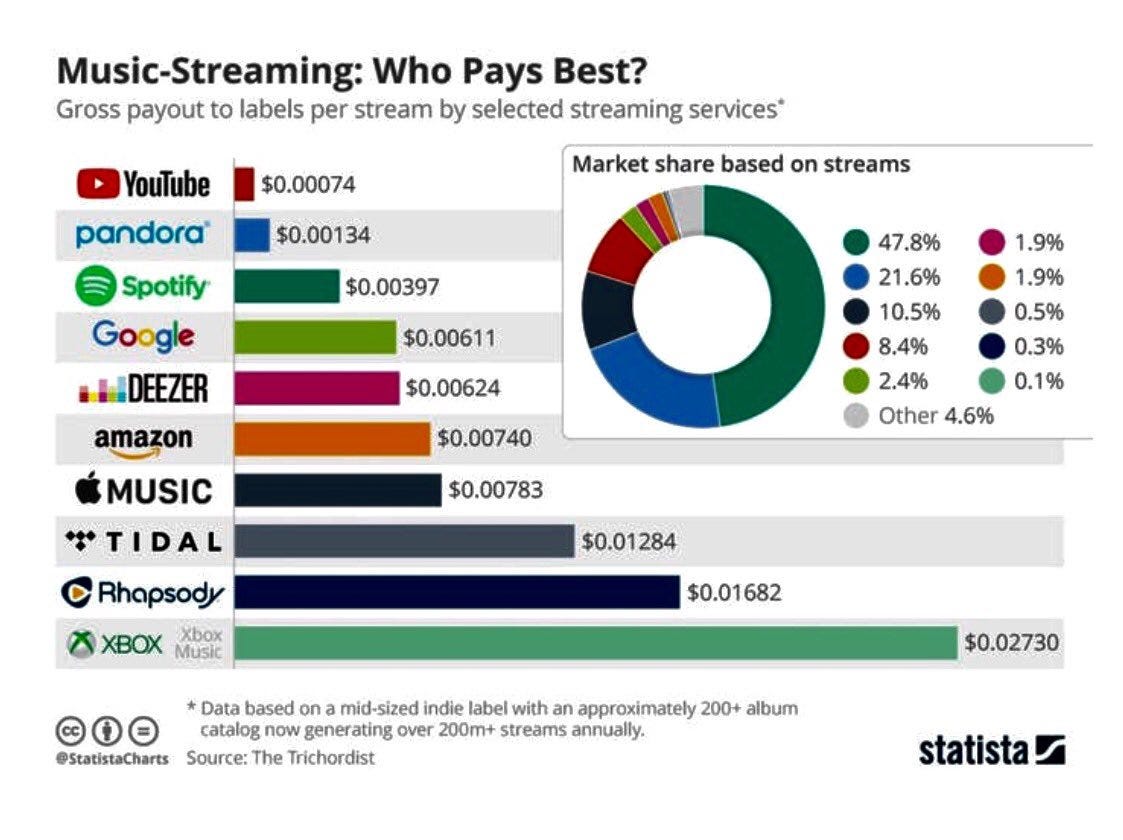
The losers in the scenario (because there has to be one) are artists and record labels who don’t get paid at their best potential on YouTube (see graph). In reaction they started to put pressure on Google, forcing them to play with the rules of the game and find a solution to the issues of unilateral benefits.
October 2015, Google unveiled their new YouTube Red service subscription, giving access to exclusive video content, ad-free experience and an included Google Play Music plan. The whole for $9.99/month, gave customers a lot more value than the competitors in the music streaming business for the same price.
In addition, they developed an app focused on music, taking advantage of the background play functionality of the Red Subscription. The YouTube Music app was born, giving access to the whole YouTube musical catalog on a single app. There is a real desire of Google to progressively manage separately the music content on YouTube, and not treat it as the other videos.
However, the media coverage was fairly poor, the idea being too abstract. Consuming content on YouTube could only be free, right?
May 17th, 2018, was the big step for YouTube Music. Google pushed the idea even further, including lots of new features:
On the paper, Google benefits from a good comparative advantage facing its competitors. Their AI implementation and video clip implementation are solid arguments to face the current giants such as Spotify and Apple Music.
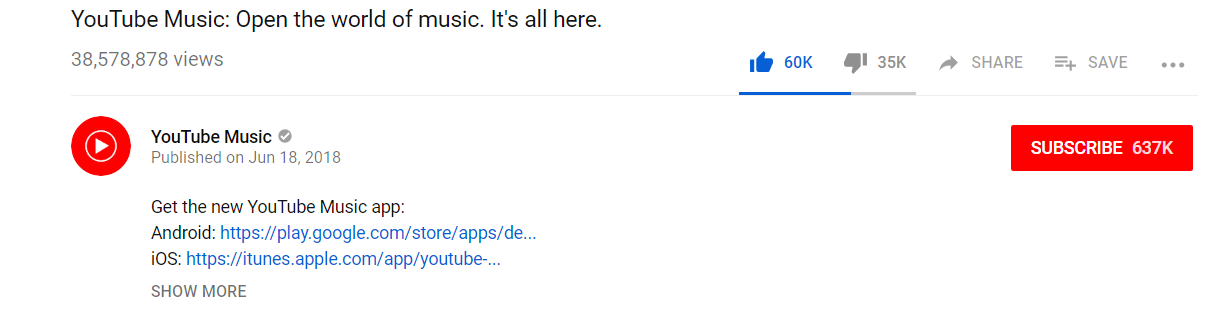
Mixed opinions on the YouTube Music ad video.
However, the public’s reaction was not heavily positive… A lot of comments (even on the french ad video) were either negative, or baffled on the concept of making users pay for music on YouTube. The same for the press: although some were very positive, others were quite confused.
In my opinion, the first mistake Google made was to use the “YouTube” brand name for a paid music streaming service. YouTube has, for long, been a symbol of free, full and unlimited content by users for users. Seeing Google introduce payment subscription systems into something that had always been free was hard to swallow for consumers.
Some reactions to this was not good at all. It just made people think that Google was charging $9.99 per month, for the ability to play music with your screen locked.
Playing music with the screen off is not supposed to be a feature, Google!
Google should have emphasized the fact that YouTube Music is BOTH: the full catalog of the other competing services and every single music on YouTube. — This is the selling point: opening the whole YouTube Music database to an already large collection of tracks makes it the widest range of music you could ever offer to a customer.
Furthermore, even more confusion is generated when people realize that Google has two music streaming services. Even though there is high chance that their end goal is to have one solid service, it remains complex for the casual consumer who wants to make the best suitable choice, without getting his head into it too much.
Google Play Music still has a solid customer base of more than 7 million (2017). My guess is, it would have been better to keep this user-base stable on their platform, and build a bridge to link Play Music to the YouTube musical content. All the money and energy that was “wasted” to market YouTube Music, could have been used to promote Google Play Music even more, with the additional new argument of having created an access to the largest database ever seen on a music streaming service: YouTube.
Google’s YouTube Music truly has the potential to be the best music streaming service out there. Its main advantages being: a super-wide range of music choices, great accessibility and advanced artificial intelligence implementation. Everything considered, YouTube Music probably offers the best service in its category, but the clumsy way Google brought it up to us didn’t go much in its favor.
The latest update on YouTube Music was the implementation of audio streaming in 256kbps (instead of 128kbps). The major competitors (Spotify and Apple Music) both allow streaming in 320kbps, so there are still some things to catch up for this young Google service.
We must keep in mind that YouTube Music remains nonetheless a pretty new product, that is in the middle of a transition phase. We should give Google more time to fully develop their vision of the perfect music streaming service.
Having used about every single music streaming apps on the market, I was nicely surprised by YouTube Music. During the 3 months I spent using it, I never found myself searching too long for a specific track: the database is gigantic, and the implementation of search with lyrics helps a lot when you don’t remember a title.
The personalized playlist was very interesting: nice balance between the songs you searched for and the ones Google wants you to discover. I found myself relying a lot on the offline personalized playlist: you can set the amount of music you want in the list, and pretty much every day, the app chooses new songs to add in exchange of some others that the AI found less relevant to your tastes. Additionally, the playlists curated by them were various and overall well made.
I barely used the video clip switch feature, maybe it’s just me, but it sounds more like a gadget than an actual selling point.
Still curious about it? I recommend you go take advantage of the free month of subscription and judge by yourself if you should resign or not.
Have a nice day.